Stories
Why the Best Gatherings Have a Sign-Up Sheet (Not a Group Chat)
A group chat is a great place to celebrate. It is a terrible place to organize.
It's 6pm on a Saturday and the group chat has 18 unreads.
You scroll up. Someone offered to make pasta but only if no one else was. Someone else asked about plates. A third person said "I can do dessert!" with three exclamation points, and then ten messages later: "wait, did we land on dessert?"
Two more replies arrive while you're reading. One is a thumbs up. One is the laughing-crying emoji.
You love these people. You also have no idea who's bringing the bread.
The chat does one thing well, and another thing badly
Group chats are optimized for warmth. They're built for the message you send when you see something funny on the way home, or the photo of the sunset, or the "running 10 min late." They reward immediacy. They forgive sloppiness. They flatten everything into the same scrolling stream: gossip, plans, jokes, the occasional gif.
Coordination needs the opposite of all of that. Coordination needs persistence, so today's decision is still findable on Saturday. Structure, so you can see the gaps at a glance. A single source of truth, so the bread doesn't get committed to twice and the salad not at all.
Asking a group chat to be a coordination system is asking a kitchen to also be a filing cabinet. It can sort of do it, but only by ruining what made it a good kitchen in the first place.
By Friday, Tuesday's "I'll do dessert!" is buried under forty-seven messages about a meme, three reschedule discussions, and a tangent about whose dog ate what. The information is technically still there. Finding it is its own evening.
When there's no sheet, the host becomes the sheet
The work doesn't disappear. It moves into the host's head.
The host becomes the air-traffic controller. Maintaining a mental tally of who said what when. Re-asking the people who never replied. Filling gaps Saturday morning. Buying backup plates because they're not one hundred percent sure anyone confirmed plates.
Doing the math on the way to the store: did Maya say she was bringing the salad, or was that Jamie? Maya said "something." Maybe that meant salad. Better grab a salad just in case.
By the time guests arrive, the host has done the work of organizing the gathering twice. Once before anyone showed up, and once in the running internal commentary they're trying to suppress while saying "no really, just sit, it's all ready."
This is how someone who loves hosting starts to dread it. Not because the cooking is hard. Because the coordination is hard, and they're doing it alone.
A sign-up sheet is a small act of generosity
A sign-up sheet isn't bureaucracy. It's not corporate. It's not formal.
It's the host saying, in advance: I'll do the thinking. You just pick a thing.
That's a generous move. It removes the negotiation. It removes the "I would but I don't know if anyone else is." It removes the "what's left?" question that nobody loves answering. Eight friends can contribute eight things, with zero pre-meeting needed, because the structure already exists and is doing the work.
The sheet isn't there to control people. It's there to make it easy to say yes.
What it does for the guests, too
The host's relief is the obvious story. The quieter story is what the sheet does for guests.
Most people want to bring something. They just don't want to be the one who shows up with the third bottle of wine when nobody brought salt. Without a sheet, contributing means a small social calculation. Text the host? Text the chat? Wait and see what other people say first? The polite default is often to wait too long, then text apologetically Saturday morning: "is there anything I can grab on the way?"
A sheet erases all of that. Open the link, see what's open, pick a thing, done. No apology. No negotiation. Nobody having to ask the host, who is already busy.
The chat thread you save by doing this, the one that doesn't have to happen, is itself a gift to everyone in it.
What it isn't, either
It's not a Google Sheet. Spreadsheets feel like work because they look like work: gridlines, formulas, the same surface as the quarterly forecast. The whole point of a gathering is that it's not that.
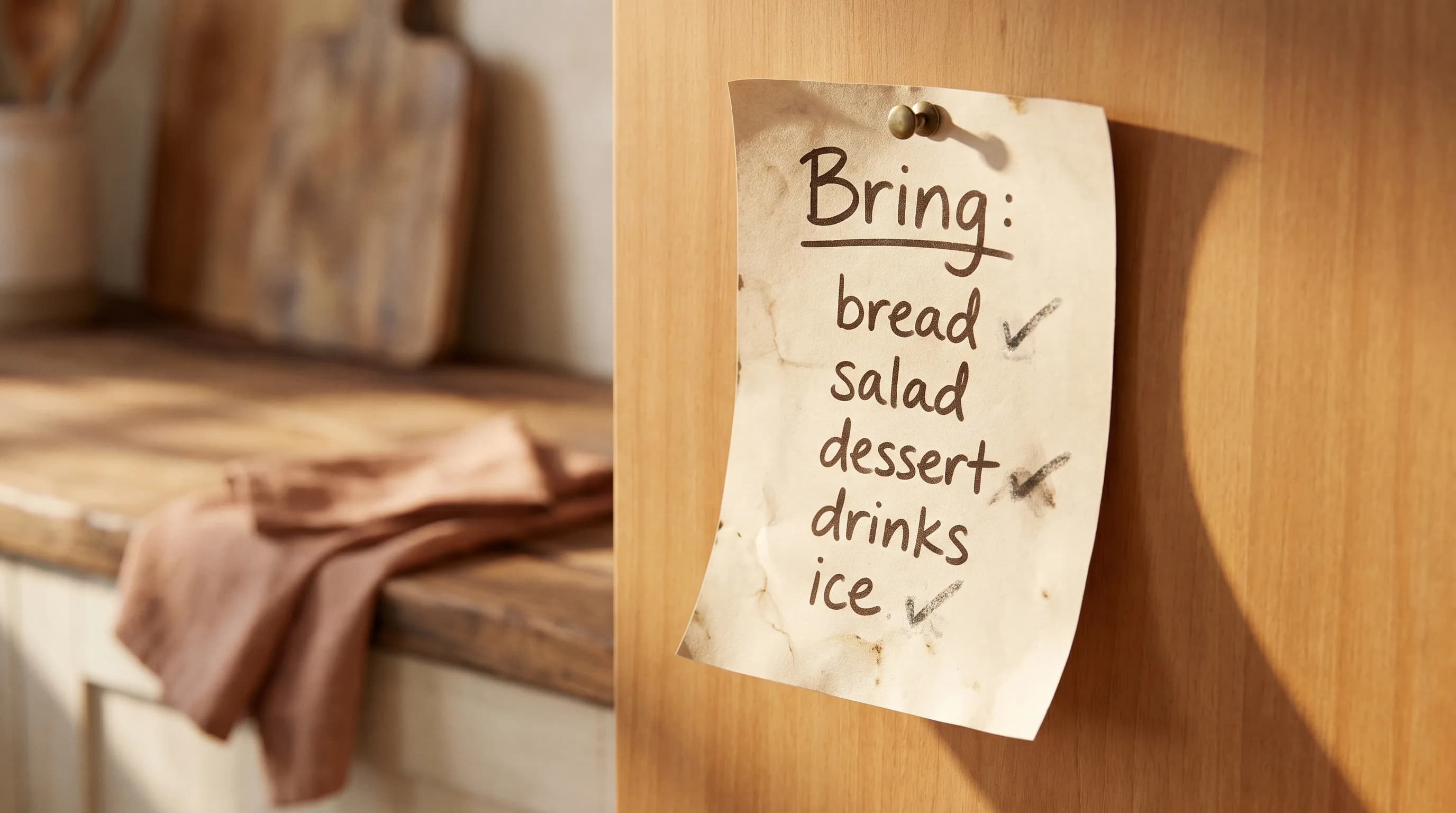
It's not a paper sheet on the fridge. That works if everyone happens to walk past the fridge before Saturday. Most don't.
It's a small bit of shared structure that lives wherever your guests already are: on their phones, no app to download, one tap to claim a thing.
The best gatherings feel effortless
They're not. Somewhere upstream, someone did the small kind work of letting everyone know what was needed and giving them an easy way to chip in. That small kind work is the whole idea behind the modern potluck playbook.
That work used to live in the host's head, or in the group chat, or both. Now it can live somewhere designed for it.
That's what we built PitchInDish to do. Less managing a project, more having a party. It just turns out the project management was the part making people stop hosting.
If you've been the air-traffic controller one too many times, give it a try. The bread will get brought. We promise.