Hosting
How to Organize a Church Potluck
Fellowship meals are big, beautiful, and a little chaotic. Here's how to coordinate one that feeds everyone — without it all landing on you.
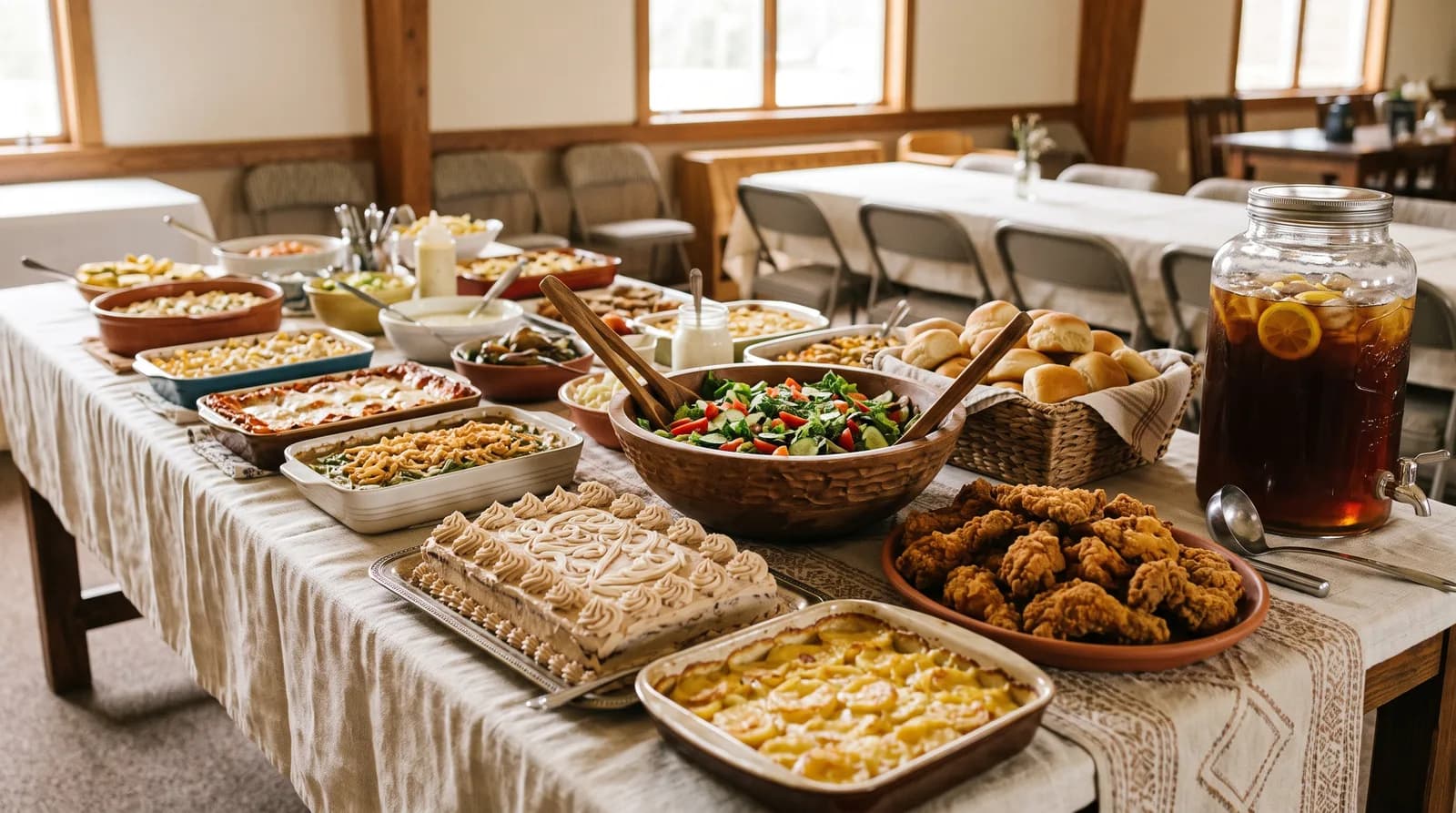
The folding tables go up the moment the service lets out. By noon they're covered end to end — three kinds of fried chicken, a pan of scalloped potatoes still warm from someone's trunk, green bean casserole, a sheet cake with somebody's grandkid's name piped across it, sweet tea in a dispenser the size of a water cooler.
A church potluck is one of the great abundances of community life. It is also, if nobody's quietly coordinating it, forty desserts and not enough forks. Here's how to organize one that feeds everyone — without the whole thing landing on you.
The short version
To organize a church potluck: pick a date and format, estimate your headcount, assign food by category (or by last name) so the spread stays balanced, open a sign-up sheet everyone can see, recruit a few setup and cleanup volunteers, and send a reminder the week before. The single most important move is the sign-up — at fellowship-meal scale, "just bring something" reliably produces a table of all sides and no mains.
1. Pick the format, and guess your number
An after-service luncheon eats differently than a Wednesday-evening supper, and a 40-person congregation plans differently than a 300-person one. Decide the shape, then get a rough headcount — ask people to RSVP so you're estimating from real numbers instead of hope. A good rule at scale: each family brings a dish that serves 8 to 12, and you plan a little long. Leftovers go home; an empty table does not.
2. Assign by category — or by last name
This is the move that makes a large potluck work. Left to chance, everyone brings what they're comfortable making, which skews heavily toward sides and sweets. Two ways to balance it:
- By category — mains and big pots, sides, salads and cold dishes, desserts, drinks and setup. (Our church potluck template lays the categories out, with big-batch dish ideas for each.)
- By last name — the classic: A–M brings a main or side, N–Z brings dessert or drinks. Simple, fair, and easy to print in the bulletin.
Either way, you're converting "bring something" into "bring something from this bucket," which is the difference between a balanced meal and a dessert convention.
3. Put the sign-up where everyone can see it
Not a clipboard that lives in one volunteer's binder. Not buried three lines deep in the bulletin. The sign-up needs to live somewhere everyone can see and update — what's claimed, what's still open — without calling the church office.
A shared link does this, and the right one asks for no account or app to view or claim a slot. That matters in a congregation that spans every age and every comfort level with technology: grandparents and teenagers should both be able to tap a link and add their dish. (If you want the anatomy of a sign-up that actually works, we wrote that up here.)
4. Cover dietary needs up front
Fellowship meals span every age and diet under one roof — diabetics, gluten and nut allergies, little kids, folks who don't eat pork. Ask people to label what they bring, and surface a small set of flags on the sign-up (vegetarian, gluten-free, nut-free). It's a small kindness that lets everyone fill a plate with confidence instead of interrogating the casseroles.
5. Recruit setup and cleanup — not just food
The food half of a potluck gets all the attention. The other half — tables, coffee, serving spoons, the dishwashing crew at 1:30 when everyone's drifting to the parking lot — is what determines whether the same three saints do everything every single time.
Put setup and cleanup in their own sign-up slots, right alongside the green bean casserole. People say yes to a clear, claimable task far more often than to a vague "we could use help."
6. Remind the week before, and plan the day-of flow
Send a nudge a few days out — who's bringing what, when to arrive, where to set up. Then think through the day-of logistics: oven and reheating coordination so it's not a 11:50 traffic jam, big drink dispensers, where the trash and recycling go, and to-go containers so leftovers can travel home with families and out to anyone who couldn't make it.
Common church-potluck pitfalls
- Forty desserts, four mains. Fixed by assigning by category or last name.
- No labels. Guests with allergies can't eat confidently, or at all.
- The host does everything. Setup and cleanup belong in sign-up slots too.
- Cold dishes sitting out for hours. Plan reheating, ice, and a serving order.
- No plan for leftovers. Bring to-go containers; send food home, especially to shut-ins.
The part that isn't logistics
For all the coordination, a church potluck isn't really a logistics problem. It's a community feeding itself, on purpose, in the same room — one of the warmest things a congregation does all month. The planning isn't the point. It just protects the point, so the day feels like fellowship instead of a fire drill.
Ready to set yours up? Start from the church potluck template or open a sign-up — it's free, and guests join from one link with no account. Not sure on amounts for a big crowd? The potluck calculator scales it to your headcount.