Hosting
How to Make a Sign-Up Sheet That Actually Works (with Templates)
The four properties of a sign-up sheet worth using, and what they look like for the gatherings you actually host.
The sheet was a Google Doc. It had one column called "What are you bringing?" and a list of fifteen names underneath. Three people had written "??". Two had written "salad." One had written "I'll figure it out." The host had filled in "main" next to her own name, which was the most useful entry on the page.
This is a sign-up sheet that doesn't work. It looks like one. It is technically one. Eight people will arrive on Saturday and there will still be no bread.
A sheet that actually works has four properties. None of them are complicated. Together they are the difference between a potluck that comes together and one where everyone brought salad.
What a real sign-up sheet does
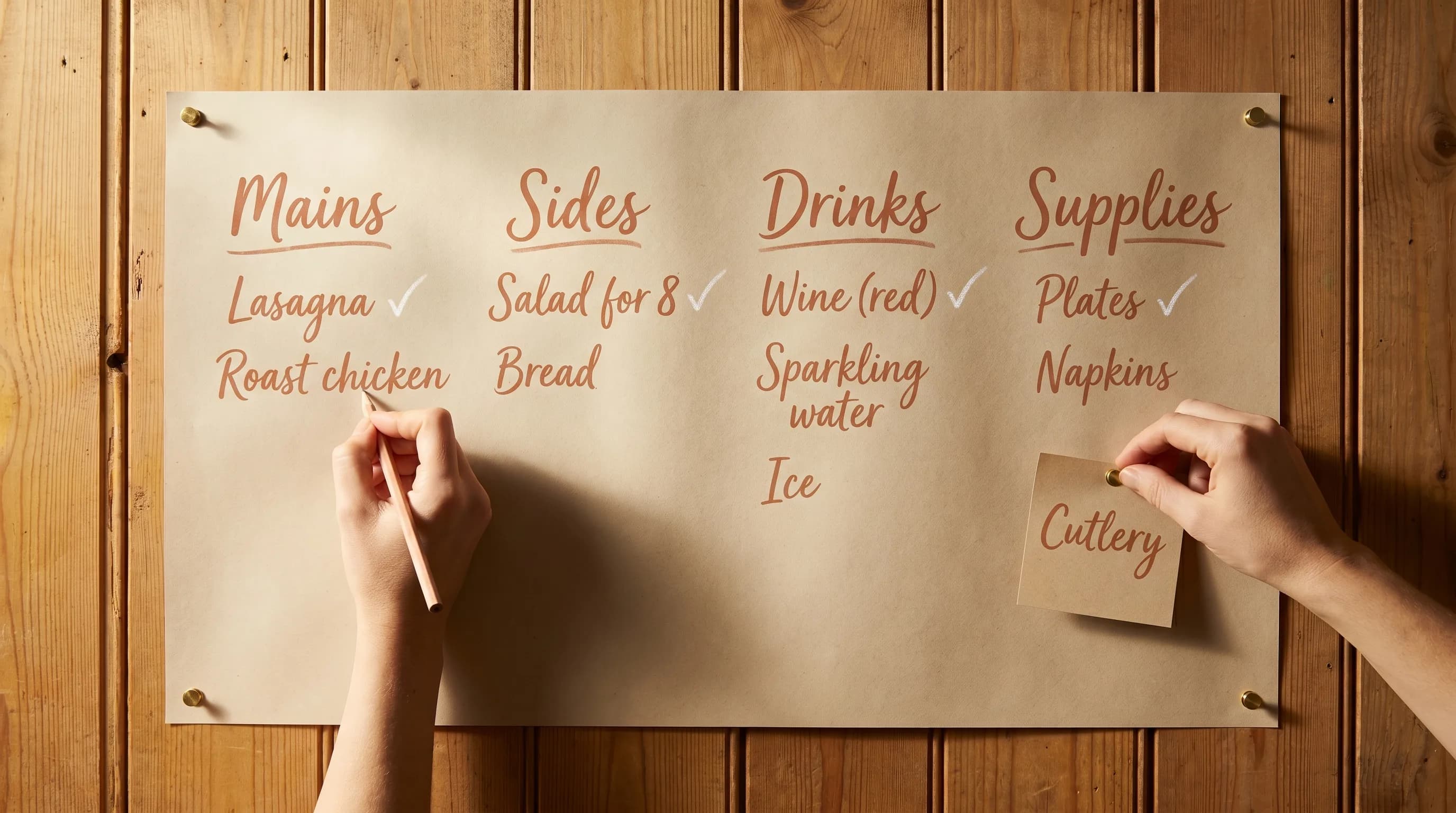
1. It groups asks by category, not by item.
The bad sheet asks "what are you bringing?" and waits. The good sheet says "we need things in these buckets, pick one." Categories let people scan to where they have a contribution and pick from there. They prevent the all-salad outcome. They prevent the no-bread outcome. They convert a blank-page question into a multiple-choice one, and a multiple-choice question is the kind humans actually answer.
The right categories depend on the gathering shape (templates below). The principle is the same: give people a small list of things they can pick from, and they pick.
2. It specifies quantities.
"Salad for 8" beats "salad." "Two bottles of wine" beats "wine." "A dozen rolls" beats "bread."
Quantities do two things at once. They remove the question of "is what I'm bringing enough?" (which most polite people answer by bringing too little). And they prevent the situation where four people each bring a small bowl of olives. A guest who sees "salad for 8" claims that line and brings exactly that. A guest who sees just "salad" brings a small side bowl, because they don't want to be the one who brought too much.
3. It surfaces dietary flags up front, not at the door.
Not as a free-text afterthought. A small structured set of flags works: vegetarian, vegan, gluten-free, nut-free, dairy-free. Guests with restrictions look at the sheet first, confirm something is going to work for them, and tell you ahead of time if nothing does.
This is also when you find out about "oh by the way Jamie's bringing his new partner, she's vegan," three days out instead of at the door. Those three days are the difference between adapting one dish at your own pace and improvising one in the kitchen while guests stand awkwardly in the entryway.
4. It lives in one central place. Not in the chat.
A group chat is where you post a photo of the salad you're planning. It is not where coordination happens. Tuesday's decision gets buried under Friday's memes. The host becomes the human source of truth, which is the air-traffic-controller problem the longer take on group chats gets into.
The sign-up needs to live somewhere persistent, where everyone can see it, where nobody has to ask the host "what's still open?". A shared link that all guests can view. One thing. One source of truth.
Templates by event type
The four properties stay the same. The categories change based on what kind of gathering it is. Here are the five shapes I host most often, with the categories I use for each. Steal them, modify them, make them yours.
Casual drop-in (open house, post-game, holiday afternoon)
People come and go. Food is grazed, not plated. Host provides the structure (drinks, plates, ice), guests fill in around it.
| Category | Examples (with quantities) |
|---|---|
| Apps to graze | Cheese board for 12, dip + chips for 12, veggie tray for 12 |
| Easy mains | Sliders for 12, big sandwich platter for 10, pulled-pork tray for 12 |
| Sweets | Cookies (2 dozen), brownies (1 pan), bakery pie |
| Drinks | Wine (2 bottles), sparkling water, ice (lots) |
| Supplies | Napkins, small plates, plastic cups |
Sit-down meal (eight to twelve at a table)
Higher coordination, fixed start time. Host provides the anchor dish, guests bring sides + dessert + drinks.
| Category | Examples (with quantities) |
|---|---|
| Anchor (host) | Lasagna for 12, brisket for 12, or roast chicken |
| Salad | Green salad for 12, grain salad for 12 |
| Vegetable side | Roasted veg for 12, dressed greens for 12 |
| Bread | Sourdough loaf, dinner rolls (12) |
| Dessert | Pie, cheese plate, fruit + cream |
| Wine | 2 reds, 1 white, 1 non-alcoholic |
Friendsgiving (extended sit-down)
Same shape as the sit-down, but bigger and more category-driven. The host owns the turkey. Everything else is on the sheet.
| Category | Examples (with quantities) |
|---|---|
| Turkey (host) | Roasted turkey + gravy |
| Stuffing | One large dish for 12 |
| Cranberry sauce | One jar or one bowl |
| Mashed potatoes | One large dish for 12 |
| Vegetable side | Two: one green, one root |
| Salad | Big mixed for 12 |
| Bread + butter | A dozen rolls + good butter |
| Pie | Two: one fruit, one cream |
| Wine | 3 bottles total |
| Supplies | Whipped cream, coffee, ice |
Brunch potluck
Different food language than dinner. Eggs and pastry instead of mains and sides. Earlier start, shorter window.
| Category | Examples (with quantities) |
|---|---|
| Eggs (host) | Frittata or strata for 10 |
| Pastry / bread | Bagels (12) + cream cheese, scones (dozen) |
| Fruit | Big fruit salad for 12 |
| Hot side | Bacon (1 lb) or sausage (1 lb) |
| Drinks | Sparkling wine (2 bottles), orange juice, coffee |
| Sweet | Coffee cake or muffins (dozen) |
Outdoor BBQ
Travel-friendly only. No oven. No microwave. Ice is mandatory.
| Category | Examples (with quantities) |
|---|---|
| Mains (host) | Burgers + buns, chicken, or ribs |
| Salads (cold) | Pasta salad for 12, slaw for 12 |
| Sides (cold or room temp) | Chips + dip, watermelon, corn salad |
| Drinks | Beer (case), seltzer, lemonade |
| Ice | Two big bags |
| Supplies | Plates, napkins, cups, bug spray |
Print these. Steal them. Modify them for your group.
What never goes on the sheet
A few things look like good entries and aren't:
- "Surprise me" or "anything you want." This is a kindness you're doing for the guest who would otherwise stand in the cracker aisle for fifteen minutes. Always give them a category.
- Anything fragile that needs to travel intact. Decorated cakes, pavlovas, towers of anything. These belong to the people physically hosting.
- Anything that needs the host's kitchen for thirty minutes. Reheating in the oven is fine. Cooking from raw is not.
- A "BYO" line with no specifics. "Bring whatever drinks you want" leads to seven open bottles of wine and no ice. Specify the gap, not the freedom.
Why digital beats Google Sheets beats paper
A real sign-up tool fits the shape of the problem. Google Sheets and paper don't.
Paper on the fridge works only for the people who walk past your fridge. Most don't.
A shared Google Sheet technically has the right properties. Categories. Quantities. Dietary flags. Persistence. It also looks like work, doesn't show real-time changes well on a phone, and requires the host to set up the columns by hand for every event. People will fill it in, then forget what they signed up for, then text the host on Friday asking "what did I say I was bringing?".
A digital sign-up tool built for this does the structural work for you. Categories pre-set. Quantities baked in. Dietary flags structured. Mobile-first. Real-time. With a confirmation email so guests have their commitment on hand. (This is what we built PitchInDish for. There are other options too. Use the one that does the four properties for you.)
The bar is low. Anything that does the four properties beats nothing. The point is to stop being the human source of truth.
The five-minute setup that buys five hours
The sheet you make is the floor for what the gathering can be. A bad sheet caps the ceiling: people bring what's easy, the gaps stay, you fill them at 5 PM. A good sheet raises it: people see what's needed, claim it, contribute, show up.
Five minutes of setting up the sheet buys five-plus hours of guest contribution. By any honest accounting, it's the highest-leverage move in the whole hosting playbook.
Stop sending "what are you bringing?" into the chat. Send a sheet.